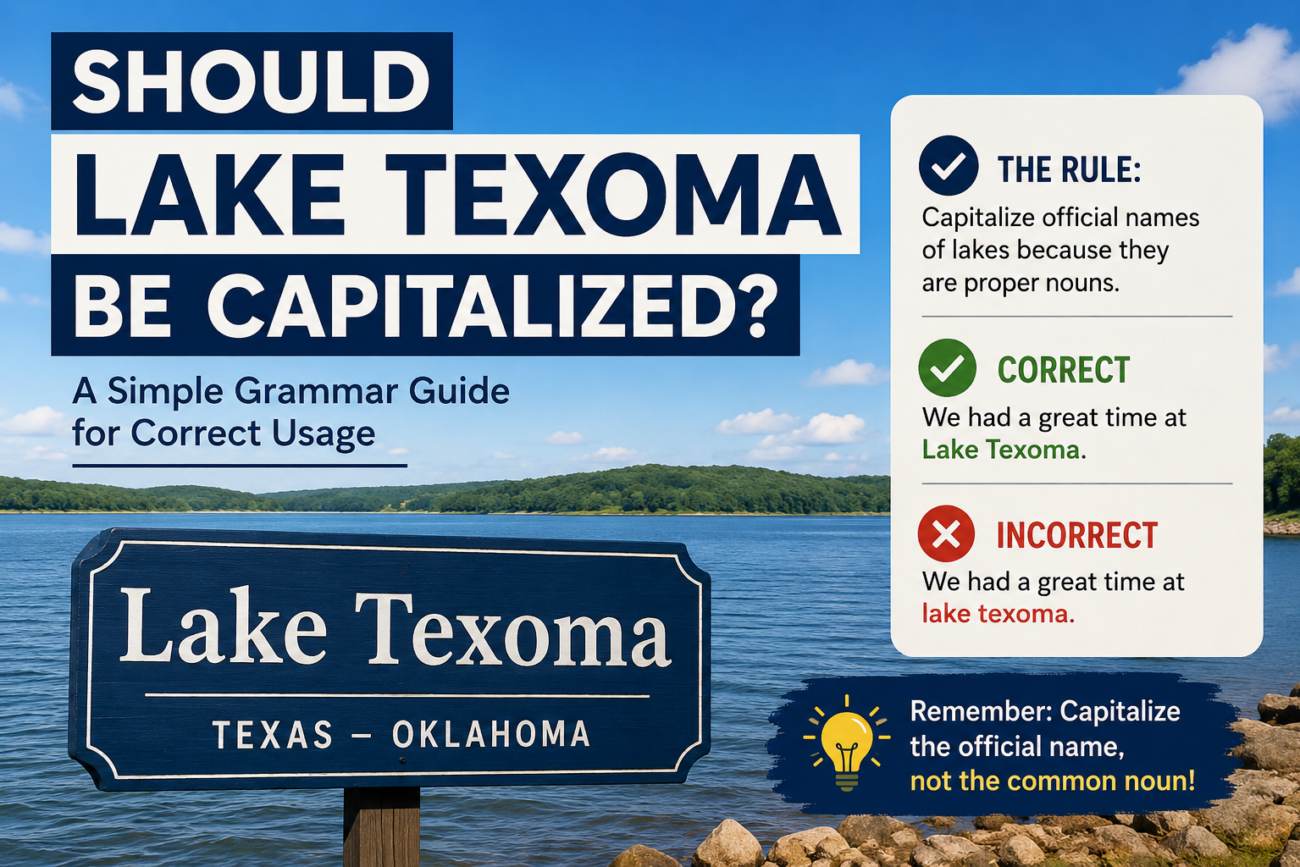
When writing about famous places, many people wonder whether certain words should begin with capital letters. One common question is whether lake texoma should be capitalized. The answer is yes, and understanding the reason can help you write with greater accuracy and confidence.
English grammar follows clear rules for capitalizing proper nouns, including official place names. Since Lake Texoma is the official name of a well-known reservoir on the Texas–Oklahoma border, both words should always begin with capital letters when referring to the lake by its proper name.
Whether you are a student, blogger, content writer, teacher, or editor, learning this simple grammar rule will improve your writing and help you avoid common mistakes. This guide explains everything you need to know about capitalization, provides examples, and answers the most frequently asked questions.
What Is Lake Texoma?
Lake Texoma is one of the largest reservoirs in the southern United States. It lies along the border of Texas and Oklahoma and was formed by the construction of Denison Dam on the Red River. The lake is famous for fishing, boating, camping, swimming, hiking, and family vacations.
Every year, visitors travel from different parts of the country to enjoy its beautiful scenery and outdoor activities. Since Lake Texoma is the official name of a specific location, English grammar classifies it as a proper noun.
Why Lake Texoma Should Be Capitalized
The reason lake texoma should be capitalized is simple. Proper nouns always begin with capital letters, and official names of lakes, rivers, mountains, countries, and cities are all considered proper nouns.
When you write “Lake Texoma,” the word “Lake” is not being used as a general noun. Instead, it forms part of the official name. Therefore, both “Lake” and “Texoma” must always start with capital letters.
This rule applies in newspapers, books, websites, travel guides, school assignments, and professional writing.
Understanding Proper Nouns and Common Nouns
Before learning capitalization rules, it helps to understand the difference between proper nouns and common nouns.
A proper noun identifies one unique person, place, organization, or landmark.
Examples include:
- Lake Texoma
- Grand Canyon
- New York City
- Pacific Ocean
A common noun describes a general thing instead of naming a specific one.
Examples include:
- lake
- city
- river
- mountain
Compare these examples:
We spent the weekend at Lake Texoma.
We spent the weekend at the lake.
The first sentence refers to a specific location, while the second refers to any lake. That difference determines whether capitalization is needed.
English Grammar Rules for Geographic Names
English grammar has one consistent rule for geographic features.
Whenever a geographic feature is part of its official name, every important word is capitalized.
Examples include:
- Lake Texoma
- Lake Tahoe
- Lake Superior
- Mississippi River
- Atlantic Ocean
- Rocky Mountains
This rule is followed in educational writing, journalism, books, travel websites, and official documents.
Because of this rule, lake texoma should be capitalized whenever it refers to the official reservoir.
When You Should Capitalize the Word “Lake”
The word “Lake” receives a capital letter only when it forms part of an official place name.
Correct examples include:
- Lake Texoma offers excellent fishing.
- Lake Michigan is enormous.
- Lake Tahoe attracts millions of tourists.
Each example refers to one specific lake.
Since these are official names, capitalization is required.
When You Should Not Capitalize the Word “Lake”
The word “lake” remains lowercase when used as a general noun.
Examples include:
- The lake looked peaceful at sunrise.
- We walked around the lake.
- Every lake has different wildlife.
Here, “lake” simply describes a body of water rather than naming one.
This is one of the easiest ways to remember the rule.
Common Mistakes Writers Make
Many writers accidentally capitalize words incorrectly.
Incorrect examples include:
- lake Texoma
- Lake texoma
- lake texoma
The correct version is:
- Lake Texoma
Another mistake is writing:
We visited the Lake yesterday.
The correct sentence is:
We visited the lake yesterday.
Understanding these differences helps improve grammar and professionalism.
Why Correct Capitalization Matters
Some people believe capitalization is only a small detail, but it has a significant impact on writing quality.
Correct capitalization helps readers understand exactly what you mean.
It also improves:
- Readability
- Professionalism
- Grammar accuracy
- Educational value
- Reader trust
Whether you write blogs, assignments, articles, or business documents, proper capitalization creates a better impression.
Examples of Correct Usage
Here are several examples showing the correct way to write the official name.
Correct:
- Our family visited Lake Texoma last summer.
- Lake Texoma is popular for striped bass fishing.
- Thousands of tourists visit Lake Texoma every year.
- The weather around Lake Texoma was perfect.
- We spent three days camping near Lake Texoma.
Incorrect:
- lake Texoma is beautiful.
- Lake texoma attracts visitors.
- lake texoma has excellent fishing.
Always capitalize both words when writing the official name.
Does Every Style Guide Agree?
Yes.
Major English style guides agree that official geographic names should be capitalized.
This includes educational writing, publishing standards, newspapers, magazines, travel writing, and professional editing.
Because the rule is universal, you never need to worry about changing the capitalization of the official name.
Simple Tips to Remember the Rule
If you ever forget the rule, ask yourself one simple question.
Is this the official name of a place?
If the answer is yes, capitalize every important word.
Examples:
Official name:
Lake Texoma
General description:
the lake
This quick trick helps avoid nearly every capitalization mistake.
Conclusion
Knowing why lake texoma should be capitalized is important for anyone who wants to write clear and grammatically correct English. Since Lake Texoma is the official name of a specific geographic location, both words should always begin with capital letters. The same rule applies to other officially named lakes and geographic features. On the other hand, when the word “lake” is used as a common noun rather than a name, it should remain lowercase. Following this simple grammar rule will make your writing more accurate, professional, and easier for readers to understand.
easier for readers to understand.
FAQs
Why should Lake Texoma be capitalized?
Lake Texoma is an official geographic name, making it a proper noun. Proper nouns always begin with capital letters.
Is “lake” always capitalized?
No. It is only capitalized when it is part of an official name such as Lake Texoma or Lake Michigan.
Can I write “lake Texoma”?
No. That is grammatically incorrect because both words in the official name should be capitalized.
Does this rule apply to other lakes?
Yes. Official names like Lake Tahoe, Lake Superior, and Lake Erie follow the same capitalization rule.
Is correct capitalization important for blog writing?
Yes. Correct capitalization improves readability, professionalism, and helps create clear, polished content for readers.
