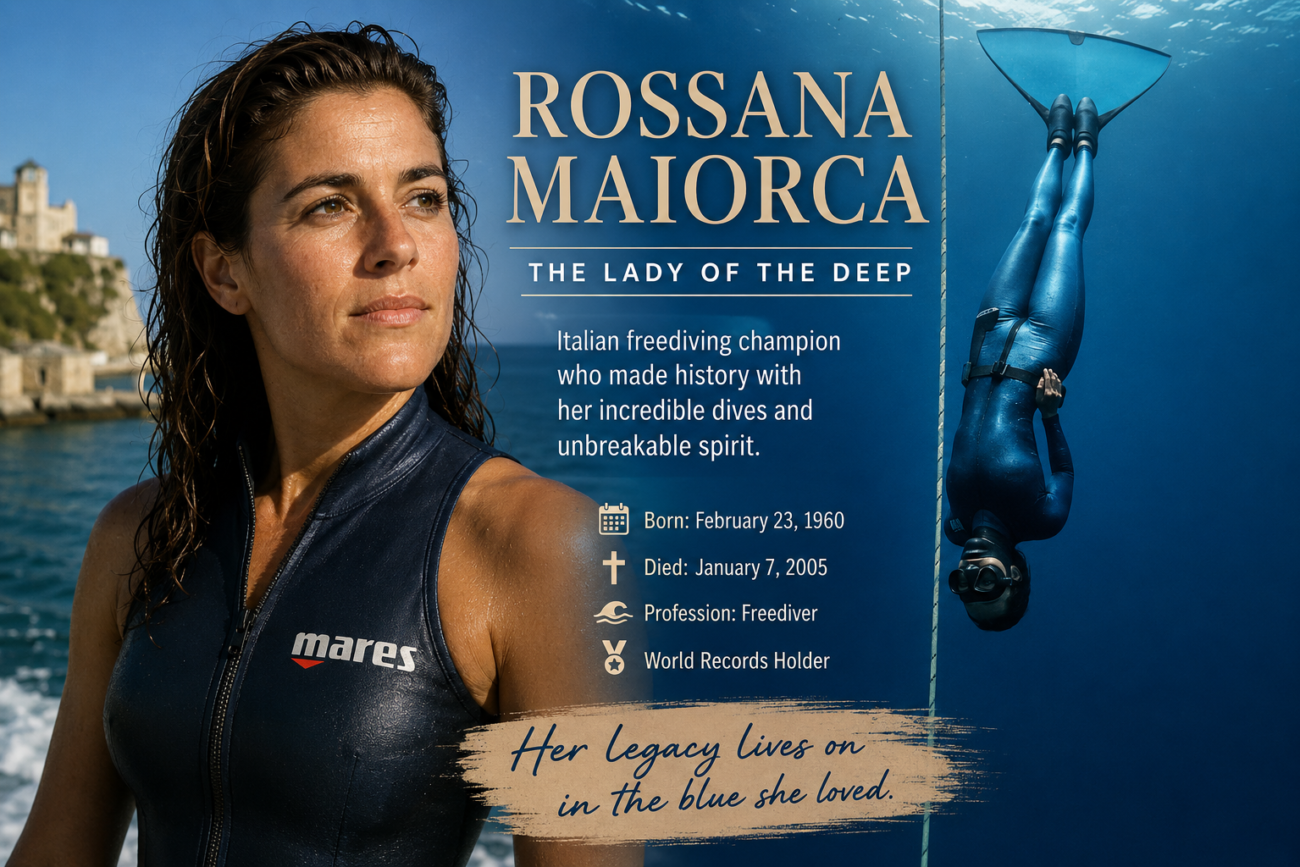
Rossana Maiorca was an Italian freediving champion whose name became closely associated with some of the most remarkable achievements in competitive apnea. Coming from a family deeply connected to the sea, she developed her talent at a time when deep freediving was still a demanding and relatively specialized sport. Her career was not simply a continuation of her famous father’s achievements; she established her own identity through a series of notable records and helped demonstrate the potential of women in a discipline that required exceptional physical control, concentration, and courage.
Her story remains closely connected with Siracusa, Sicily, where several of her most important dives took place. Even decades after her competitive career, her achievements continue to be remembered through sporting tributes, memorial projects, and events celebrating her connection with the sea. This article looks at her early life, sporting career, records, family background, death, and the legacy she left behind.
Who Was Rossana Maiorca?
Rossana Maiorca was an Italian champion freediver and one of the prominent female figures in the early development of competitive apnea. She was born on February 23, 1960, and became involved in deep diving through the strong influence of her family and the marine environment of Sicily.
She was the daughter of Enzo Maiorca, the celebrated Italian freediver who became internationally known for his pioneering achievements in underwater diving. Rossana and her sister Patrizia both followed their father’s passion for the sea. However, Rossana eventually developed a competitive career of her own and became recognized for setting world records.
Historical accounts describe her as a determined athlete who competed during an important period in the development of freediving. Her achievements helped establish her as more than simply the daughter of a famous sportsman.
Early Life and Family Background
The sea played an important role in the Maiorca family. Enzo Maiorca’s career had already brought considerable attention to deep apnea, and his daughters grew up surrounded by the sport and the culture of underwater exploration.
Rossana’s older sister, Patrizia Maiorca, also became involved in competitive freediving. The two sisters spent years competing and developing their abilities in a sport that demanded careful preparation and remarkable breath control.
This family environment gave Rossana an unusual introduction to freediving. Instead of approaching the discipline as a casual hobby, she became part of a family that understood the technical, psychological, and physical challenges involved in deep diving.
Rossana Maiorca and Her Freediving Career
Rossana Maiorca’s competitive career began at a relatively young age. One of her earliest major achievements came in 1979, when she reportedly reached 40 meters in constant-weight apnea at Fontane Bianche near Siracusa. She was only 19 at the time. Historical records describe this as the first of a series of world-record performances.
Her progress demonstrated how quickly she was developing within the sport. Rather than relying entirely on her family reputation, she continued pushing her own limits and became a recognized competitor in women’s freediving.
Her career included both constant-weight and variable-weight disciplines. These categories involved different techniques and equipment, making each record a separate demonstration of athletic and technical ability.
Major World Records
One of the most important parts of her sporting history is her series of record-setting dives.
In 1979, she reached 40 meters in constant-weight apnea. Later, she achieved a 50-meter record in variable-weight diving at Milazzo in 1982, according to historical biographical records. Her achievements continued into the late 1980s, including an 80-meter variable-weight performance reported in 1988.
Her best-known achievement came in 1992. At Fontane Bianche, she reached 58 meters in constant-weight apnea, improving on the 56-meter mark she had achieved the previous summer. Contemporary reporting identifies the 58-meter dive as her final world record.
These performances were particularly significant because competitive freediving requires an athlete to descend and return to the surface while managing limited oxygen, pressure changes, physical strain, and psychological stress. Records in the discipline therefore represent much more than simply reaching a particular depth.
Why Her Records Were Important
The importance of her achievements extends beyond the numbers attached to her dives. During the period in which she competed, women’s participation in extreme-depth freediving was still developing.
Her performances demonstrated that female athletes could compete at extraordinary depths and establish international records. Her story could also inspire young women to challenge stereotypes and view sport as an important area of personal development.
Her achievements contributed to the growing visibility of the Maiorca name within international freediving. At the same time, her records remain a distinct part of her own sporting legacy.
Rossana Maiorca and Enzo Maiorca
The relationship between Rossana and her father is an important part of her biography. Enzo Maiorca was one of Italy’s best-known pioneers of deep freediving, and his influence naturally shaped his daughter’s sporting development.
However, it would be misleading to describe Rossana only through her father’s reputation. Her own record performances established her as a champion in the discipline. Her 40-meter constant-weight record at 19, later achievements in variable weight, and eventual 58-meter constant-weight record gave her an independent place in the history of freediving.
The family’s connection with Siracusa also became an important part of the city’s sporting identity. Her achievements helped reinforce the area’s reputation as a place closely associated with the sea and underwater sport.
Later Life and Career
After ending her competitive diving career, she remained connected with the diving industry. Historical accounts state that she worked as a representative for Mares and had served as a testimonial for the company for years.
Her retirement from competition did not erase her influence within the sport. Instead, her previous records and public profile continued to associate her with freediving and the marine world.
Her life was cut short in January 2005. Contemporary reporting stated that she died in hospital in Mestre after being treated for a tumor.
When Did Rossana Maiorca Die?
Rossana Maiorca died in January 2005 at the age of 44. Contemporary reports identify January 7, 2005, while some later local sources refer to January 6. Because of this discrepancy, it is safest to describe her death as occurring in early January 2005 rather than presenting the conflicting dates as equally certain.
Her death was widely mourned in Siracusa and among people connected with diving. She had achieved international recognition at a relatively young age, making her passing especially significant to the sporting community.
Memorials and Legacy in Siracusa
The legacy of Rossana Maiorca has remained visible in Siracusa. The city has honored her memory through public recognition and memorial initiatives. A cycling path in Siracusa was dedicated to her, reflecting her importance to the city and her contribution to sport.
A bronze mermaid sculpture was also created in her memory and placed underwater in the Plemmirio marine area. The sculpture was designed as a tribute to her relationship with the sea and her career as a freediver.
These memorials show that her story has continued beyond official record books. Her name has become part of the cultural and sporting landscape of the area.
The Rossana Maiorca Award
Another important tribute is the Premio Rossana Maiorca. The award was established in her memory and became associated with people who helped promote knowledge of the sea around Siracusa through areas such as sport, culture, literature, craftsmanship, and business.
Her name has therefore come to represent more than competitive achievement. The award connects her memory with wider appreciation for the marine environment and the people who contribute to the culture and protection of the sea.
Why Rossana Maiorca Is Still Remembered
The continuing interest in her life comes from several parts of her story. She was a successful athlete, a record holder, a member of a famous diving family, and a woman who competed at a time when women’s achievements in extreme sports were receiving increasing recognition.
Her story is also particularly meaningful because her records were achieved through discipline rather than simply natural ability. Deep freediving requires preparation, breath management, physical conditioning, knowledge of pressure, and the ability to remain calm in an environment where mistakes can have serious consequences.
Her achievements remain an example of how sporting records can become part of a city’s cultural memory. In Siracusa, her name continues to be associated with the sea that played such a central role in her life.
Frequently Asked Questions
Who was Rossana Maiorca?
Rossana Maiorca was an Italian world-record freediver and daughter of renowned freediver Enzo Maiorca. She became one of the notable female athletes in competitive apnea.
What was her deepest record?
Her best-known constant-weight record was 58 meters, achieved at Fontane Bianche near Siracusa in 1992.
When did she die?
She died in January 2005 at the age of 44 after an illness.
Was she related to Enzo Maiorca?
Yes. Enzo Maiorca was her father, while her sister Patrizia also became involved in freediving.
How is she remembered today?
She is remembered through her freediving records, sporting tributes, memorial projects in Siracusa, and the Premio Rossana Maiorca.
Conclusion
Rossana Maiorca left an important mark on the history of Italian freediving. From her first major record at 40 meters to her 58-meter constant-weight achievement in 1992, her career showed extraordinary determination and skill. Her connection to Enzo Maiorca introduced her to a remarkable sporting tradition, but her own records established her independent reputation.
Although her life ended prematurely in 2005, the memory of Rossana Maiorca has continued through Siracusa’s sporting and cultural tributes. Her records, memorials, and influence on the visibility of women in freediving ensure that her contribution remains an important part of the history of underwater sport.
